Comparison of different interval training methods on athletes’ oxygen uptake: a systematic review with pairwise and network meta-analysis
Article information
- Authors
- Qiushi Yang, Junli Wang, Dongyang Guan
- Journal
- BMC Sports Science, Medicine and Rehabilitation
- Publisher
- Springer Nature (BMC)
- Original publication date
- Original source
- View article at the original source (opens in a new tab)
Abstract
Background and Objective:
Maximal oxygen uptake (VO₂max) is a key indicator of cardiorespiratory fitness and endurance performance in athletes. Different interval training methods are widely used to improve aerobic capacity. This systematic review and meta-analysis aimed to compare the effectiveness of different interval training approaches in improving VO₂max among athletes.
Methods:
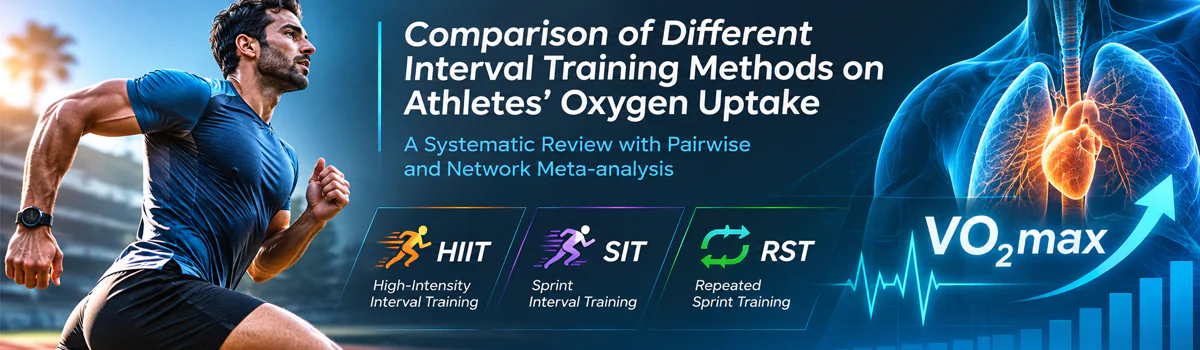
This study conducted a systematic review with pairwise and network meta-analysis, including 51 studies involving 1,261 athletes. Three interval training approaches were evaluated: high-intensity interval training (HIIT), sprint interval training (SIT), and repeated sprint training (RST).
Results:
All three interval training methods significantly improved VO₂max compared with conventional training. RST achieved the highest position in the probability-based ranking; however, no statistically significant differences were identified among HIIT, SIT, and RST.
Conclusion:
HIIT, SIT, and RST are all effective approaches for improving aerobic capacity in athletes. The selection of an appropriate interval training method should consider individual characteristics, training objectives, and practical conditions.