
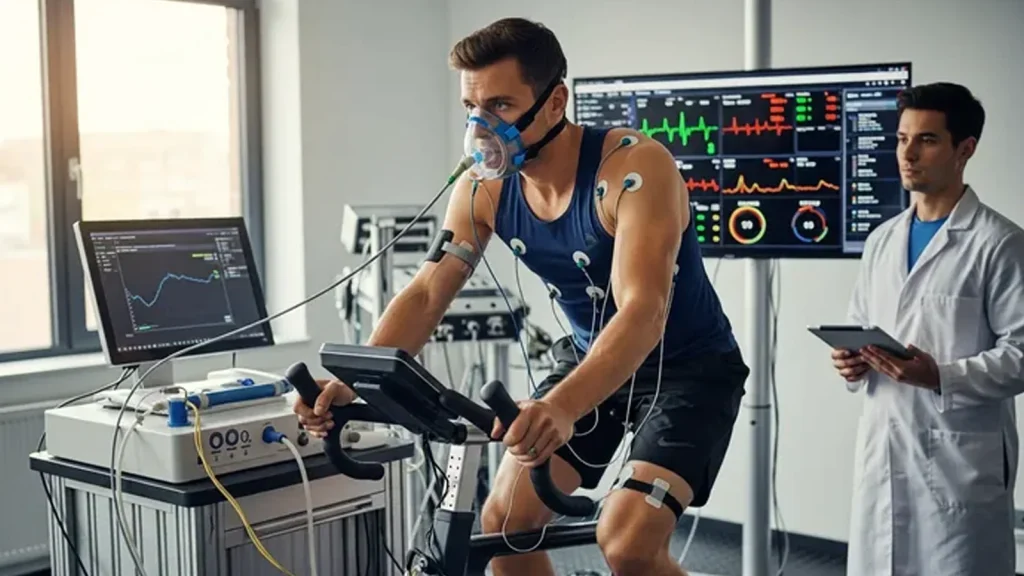
Hypoxia Produces Limited Additional Metabolic Changes During High-Intensity Interval Exercise
A new study published in Experimental Physiology suggests that performing high-intensity interval exercise under reduced oxygen availability does not necessarily produce greater acute metabolic responses than exercise in normal oxygen conditions. Researchers examined 18 inactive adults with overweight and found that continuous hypoxia reduced exercise power output and arterial oxygen saturation, while changes in measured energy-related metabolites remained broadly similar across exercise conditions. The findings highlight the distinction between physiological stress and metabolic responses.
Metabolic Responses to High-Intensity Interval Exercise Under Hypoxic Conditions
High-intensity interval exercise (HIIE) involves repeated bouts of vigorous activity separated by recovery periods. This form of exercise produces substantial physiological responses and is widely investigated in studies of energy metabolism and exercise adaptation.
Training under hypoxic conditions, where oxygen availability is reduced, has also attracted interest as a potential method of modifying exercise-related physiological stress.
However, whether hypoxia produces additional changes in circulating metabolites during high-intensity interval exercise remains uncertain.
A study published on November 7, 2026, in **Experimental Physiology** investigated plasma metabolomic responses to high-intensity interval exercise performed under different oxygen availability conditions.
Study Design and Experimental Conditions
The study involved 18 inactive individuals with overweight who completed exercise sessions under four randomized experimental conditions on separate days.
These conditions included:
– Exercise and recovery under normal oxygen availability
– Exercise and recovery under hypoxia
– Exercise under normal oxygen conditions with recovery under hypoxia
– Exercise under hypoxia with recovery under normal oxygen conditions
During hypoxic exposure, the fraction of inspired oxygen was approximately 14%, compared with approximately 21% under normal sea-level conditions.
Participants completed a high-intensity interval exercise protocol consisting of six vigorous work bouts.
Venous blood samples were collected before and after exercise. Researchers used liquid chromatography–mass spectrometry and proton nuclear magnetic resonance spectroscopy to characterize changes in plasma metabolites.
Continuous Hypoxia Reduced Exercise Performance
The results demonstrated that mean power output was lower when both exercise and recovery were performed under hypoxic conditions compared with the other three experimental conditions.
Arterial oxygen saturation was also significantly lower during continuous hypoxia.
These findings indicate that reduced oxygen availability can impair mechanical performance during repeated high-intensity exercise.
Metabolic Changes Following Exercise
Across all experimental conditions, researchers observed significant increases in pyruvate and related metabolites, including lactate, alanine, and citrate.
The lactate-to-pyruvate ratio also increased following exercise, regardless of oxygen availability.
In addition, concentrations of saturated, monounsaturated, and polyunsaturated free fatty acids increased, while selected saturated and monounsaturated triacylglycerol classes decreased.
These changes reflect substantial acute responses in carbohydrate and lipid metabolism following vigorous exercise.
Importantly, however, the magnitude of these metabolite responses did not differ significantly between the four experimental conditions.
Thus, although hypoxia influenced exercise performance and oxygen saturation, it produced limited additional effects on the measured circulating metabolites.
Implications for Exercise Physiology
The findings suggest that greater physiological stress associated with reduced oxygen availability does not necessarily translate into larger measurable acute metabolic responses.
This distinction is relevant to exercise physiology because reductions in performance or oxygen saturation should not automatically be interpreted as evidence of enhanced metabolic adaptation.
Nevertheless, the study assessed acute responses to individual exercise sessions rather than long-term training adaptations.
Consequently, the results cannot establish whether repeated hypoxic training would produce different effects on fitness, body composition, or metabolic health over time.
The relatively small sample and reliance on circulating plasma metabolites also limit the extent to which the findings can be generalized to other populations or interpreted as a complete representation of tissue-specific metabolism.
Overall, the study emphasizes the importance of integrating exercise performance, oxygenation measurements, and molecular analyses when evaluating physiological responses to hypoxic exercise.
News source
- Journal or institution
- Experimental Physiology
- Source publication date
- 2026-11-07